Posts

Basset horn & live electronics: Electroclarinet 3

Image
Looking for the studio album? Visit www.electroclarinet.com During my guest talk on Music & digital art , I premièred Electroclarinet 3 , a new composition for basset horn & live sound processing. The piece is an homage to Carl Maria von Weber , who composed lots of great music for clarinet. The theme, which manuscript you can see above, was inspired by the theme from Weber's Opus 33 (7 variations for clarinet & piano). At a larger scale, the form draws on Weber's composition as well: Theme Four parts corresponding to the Variation III (Adagio) of the Opus 33 Coda referencing the Opus 33's final seven measures I couldn't resist including a "WEBER" series of notes: W  Mi / E E   Mi bémol / Eb B   Si bémol / Bb E   Mi bémol / Eb R   Ré / D In the coda, these notes are transposed for the basset-horn:
Spectral music in Boston

Image
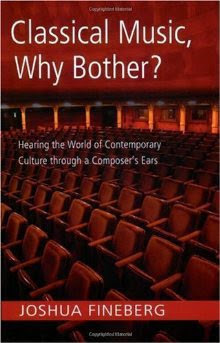
Yesterday, the Boston Musical Intelligencer published an interview of Joshua Fineberg by composer David Dominique. I was lucky to work with Joshua Fineberg during my time at the Harvard Music Department . He was a great tutor when I was writing the article A Tutorial on Spectral Sound Processing Using Max/MSP and Jitter . But don't get fooled by the spectral word: I was not really talking about spectral music . To know more about spectral music, make sure you read the interview, and—even better—attend the concert on Saturday, March 26, 8p.m. at Boston University’s College of Fine Arts Concert Hall. You'll hear ensemble Sound Icon perform Fineberg's Recueil de Pierre et de Sable and Gérard Grisey 's Partiels . Joshua Fineberg's 2006 book: Classical Music, Why Bother?

Labanotation in Perpetuum mobile

Image
Last week, I promised I would tell you more about my recent meeting with Jacqueline Challet-Haas: I wanted to check the dance notation of my Perpetuum mobile , a composition for dancing clarinetist. (Perpetuum mobile starts at around 2:27 in the video PPP for dancing clarinetist .) An excerpt from my dissertation. I have been interested in dance notation for years, and especially since the composition of Wu jú sè , a quartet for clarinet, double bass, five Chinese opera gongs, and dancer—incidentally, the first piece I composed in my Arc-en-ciel cycle. I chose then to use Labanotation (kinetography Laban), rather than other movement notation systems. I have been lucky to work several times with Jacqueline Challet Haas, the leading specialist of Laban notation in France. In August 2007 with Jacqueline Challet-Haas Jacqueline Challet-Haas will be a guest at the Conservatoire de Strasbourg during their event Rudolf Laban, le danseur de cristal , June 17-19, 2011. I think I'll be...

Ballet books

Image
Last Monday, I was in Paris to meet with Jacqueline Challet-Haas, the French specialist of dance notation, and more precisely of kinetography Laban (Labanotation). We talked about numerous topics, including labanotation (I'll let you know more about that next week) and my interest in classic ballet. I didn't know she had written a reference on the subject (in French): Manuel pratique de danse classique . Jacqueline is such an expert in movement analysis that I'm looking forward to reading her manual: I thank her very much for offering me a copy. The table of contents reads like this: Éléments de base (page 15) La barre (page 105) Le milieu, les pas (page 155) Fourth part (page 231) including table of common defaults and list of steps notated in kinetography Laban There are several editions of the book. The latest, from 2009, is there: Manuel Pratique de Danse Classique and at the publisher's site: Ressouvenances . Ballet books in English I started reading about bal...

Harvard Music Library in the news

Image
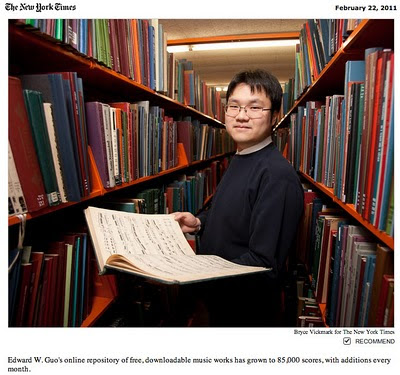
This is the untold story of this week's New York Times article on the International Music Score Library Project . It features a prominent picture of the IMSLP founder, with the following caption: Edward W. Guo's online repository of free, downloadable music works has grown to 85,000 scores, with additions every month. But what the journalists don't mention is that Mr. Guo was photographed in another beautiful score library: the Harvard Music Department's Loeb Music Library . And today, there are still more music scores in this library than in the IMSL (more than 168,000). The IMSL is very useful to find public domain scores. But make sure you visit Harvard's Digital Scores & Libretti : you will find treasures there. An excerpt of Mozart's Magic Flute overture. To get the news on newly digitized scores, read the Loeb Music Library's blog ...

Sound & digital art: guest talk

Image
This Thursday, February 17th, I'm talking in the Cafés numériques ( digital cafés ) series. My talk is entitled Le son et l'art numérique (sound & digital art - link to more information on the series) I'm focusing on two topics: What does it mean to talk about digital sound and analog sound? what sound is short history of audio recording technology LP record versus CD why artists today (like Jay-Z & Kanye West) are still recording & mixing with analog gear in studios such as Peter Gabriel's great place advantages of digital technology... including the fact that almost anybody can play with sounds today! Inside a LP record groove: picture by Chris Supranowitz Do we compose differently with digital technology? Well, I'm answering the question in a very applied way: as part of the talk, I'm performing the première of Electroclarinet 3 , a new composition for basset-horn & live electronics.

Local news

These days, local means France: have a look at the article Les Échos recently featured on Harvard and the Harvard Club de France . But even more local means the Belfort-Montbéliard area, between Lyon and Strasbourg. Tomorrow Monday, I am the guest of Maïté's Pause Café on France Bleu Belfort Montbéliard at 1:30 p.m. That should be fun. But I doubt this program will be streamed, sorry!