Posts

2-5/60 - Saturation - Contest!

Image
I am delighted to dedicate the 4 new minutes of the 60/60 project to a generous participant, and close relation of mine, Brigitte Urien . Saturation is a musical setting of Ruth Lepson 's poem Saturation (yes, it's the same title,) featuring the poet herself as the main speaker. Remember, I met Ruth last summer, and we had fun performing and improvising together . Saturation , the poem, was published in the review Carve - poems in August 2006.     Saturation in Music and Poetry Among the four great presents that I received for this piece, the one that surprised me the most is The New Media Reader . It is a fascinating book, that puts into perspective the Internet with the Oulipo movement, Eliza , and other essential projects of the 20th century. It gave me the idea of using Speech Synthesis to read a few sentences of the poem. This book addresses the concept of Saturation , not in water like the poem, but in information and communication. Speech Synthesis sounds l...

1/60 - Cell 1 - My first ringtone!

Image
My first composition for cell phone! Click play to listen, and click on "1/60 - Cell 1" to go to last.fm and download the file. If your cell phone accepts mp3 ringtones, you should manage to use this one easily (check your manual...) Jean-François Charles – 1/60 - Cell 1 Maybe you recognize these bells: I just extracted them from 1/60 - Aria . You can listen again to the Aria: Jean-François Charles – 1/60 - Aria Each bell has its own sound In the Alps, each bell is different. There is a chance component in the process of fabrication that makes each sound unique. The sound depends also on the beater you use. In this recording, to stay within the theme of 1/60 (human / machine, natural / artificial), I produced artificial bell sounds, and I tried to give each bell a slightly different character. I used a physical modeling audio software, that enabled me to modify the "material" of the bells, and other parameters, such as how the beater bounces on the...

Fun teaching in Helsinki

Image
In March 2007, I was invited by Andrew Bentley and Sibelius Academy to give a week of lectures and workshops in Helsinki. The topic was live electronics - spectral sound processing with Max/MSP and Jitter . Andrew Bentley is not only a real connoisseur of the developments of electronic music (he was an early actor of the Composers Desktop Project ), but also a singular artist: I hope I will be able to let you know more about his art in the future. I really enjoyed teaching there, and the conditions were ideal: there was a team of 10 students, active and interested. each student worked on a computer with the proper software installed (Max/MSP/Jitter, from Cycling 74 .) we met every morning during 3 hours, over 5 days. Every morning, we had time for some new concepts, as well as hands-on patching, or collective thinking about design and other topics. Gig at the Feeniks Club Every Thursday night, the Academy's café is turned into a music club. Would that be great if every ...

1/60 - Aria

Image
Do you remember the 60/60 composition project ? I am thrilled to dedicate the first minute to Katherine Lee , who chose in the original list the CD Bach: The Goldberg Variations 1955 Performance: Zenph Re-performance . Here is my composition, titled Aria . Click play to listen:   Music, humans, and machines In the CD that Katherine offered me, the version of the Goldberg Variations raises many questions. The piano plays by itself: it is a Yamaha Disklavier Pro . The Zenph team prepared a high resolution MIDI version of Glenn Gould's famous 1955 interpretation , and recorded the electronically driven piano. They even produced a concert during which the piano played by itself Glenn Gould's interpretation. But the best is here: what do you think about this quote from the booklet ? "In effect, a long-dead pianist can now give live performances or make recordings of interpretations that are still recognizably his ." Speaking about humans and machines making mus...

Homage to Maurice Merle

Image
Plex - alto saxophone version On May 6th, 2004, with numerous friends of Arfi's ( Association à la Recherche d'un Folklore Imaginaire ) and Maurice Merle's, we met together at in Lyon, France, in Théâtre des Jeunes Années for the night "Le Souffle Continue." Philippe Gilbert (sax) and myself (live electronics) played Plex , and I dedicated this version with alto sax to Maurice Merle. Here is the recording: Short biography Maurice Merle was born on April 27th, 1945 in Le Puy, France. He graduated from a business school, and became a saxophonist, composer, and arranger. He creates in 1968 the Free Jazz Workshop with Jean Mereu , Jean Bolcato, and Pierre Guyon. With Christian Rollet , he is at the origin of La Carrérarie , a company of Musical Theater for Children. Since 1972, he has created numerous shows, from l'Opéra Jubjub to Prismo , along with Steve Waring and Alain Gibert . In 1977, he is among the founders of Arfi, and has played in the most ...

Working with Karlheinz Stockhausen - The art of performing

Image
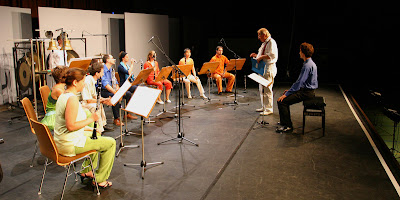
Dress rehearsal, August 2003. As an homage to Karlheinz Stockhausen , I want to share with you a text I wrote in 2003, right after working with the composer. Several noteworthy aspects of his work have not been given much importance in the comments after his passing away. One of them is the importance of performance practice in his music. That's one of the memories we musicians will keep after having performed the world première and recorded Rechter Augenbrauentanz ( The Dance of the Right Eyebrow ). The musicians clarinet and solo Eb clarinet : Michele Marelli clarinets : Rumi Sota-Klemm (by the way, Rumi played basset-horn in Montag aus Licht ), Antonia Lorenz, Roberta Gottardi , Maja Pawelke, Jean-François Charles bass clarinets : Petra Stump and Heinz-Peter Linshalm synthesizer : Antonio Pérez Abellán percussion : Michael Pattmann conductor : Adrian Heger In the recording studio, August 2003. Impressions (2003) Stockhausen is a master in performance practice...

Nigritella nigra - Black Vanilla Music

Image
A composition for clarinet and string quartet Nigritella nigra 's first part (until 3'50'') consists in a chord which color changes through the use of microtones. This is a musical image of the flower's vanilla scent. The short central passage (until 4'15'') is a deforming mirror. After that comes a distorted retrograde of the first part. The concentration of energy in microtones in the first part is transformed in more extravert gestures in the second part. The flower Nigritella nigra has a strong character! Avignon - Acanthes I composed Nigritella nigra in 1998, for my first participation to the contemporary classical music center Centre Acanthes . Sofia Gubaidulina was the guest composer, while Viktor Suslin was responsible for the composition workshop. You are listening to the recording of the final concert, featuring musicians from the Orchestre Lyrique de Région Avignon-Provence , conducted by Sylvio Gualda: Didier Breuque, clarinet D...