Monday, November 30, 2009

Robert Henke's life with Max

Robert Henke Max Cycling74

On the new Cycling 74 web site, you can read an interview with Robert Henke. Artist known as monolake, he very close to the Ableton Live team. He was a guest at expo74, cycling 74's first user conference in April 2009. That was refreshing to hear him recount his "life with Max". But the best was when he told his feature requests during the open session with the Max & Jitter team!

Robert Henke lives with Max
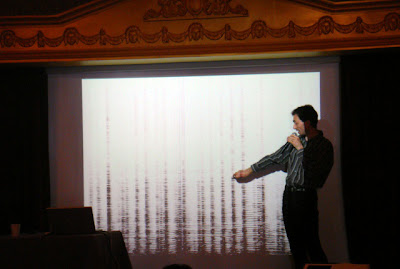
Robert Henke presents "his life with Max" at expo74 (April 2009)

Robert Henke Atlantic Waves Max Patch
Atlantic Waves: a collaborative sequencer played by himself in Berlin and deadbeat in Montréal

I like the first minute of this interesting video where Robert Henke talks about sound quality.
If it sounds good, it sounds good. Who can disagree with that?

Wednesday, November 25, 2009

You need Max, but not all the time

Max MSP alternatives

During the electroacoustic music week at the Shanghai Conservatory of Music, each of the invited Prisma composers gave a talk to present his current research. I spoke in the afternoon of October 20th in the conservatory's Golden Hall.

After an introduction to spectral domain sound processing with Max, I presented alternatives for artists to create music with interactive electronics.

Why you need Cycling74's Max

Jean-Francois Charles spectrogram Shanghai
Listening to the sound, and looking at it, too.

Jean-Francois Charles Golden Hall Shanghai Conservatory
On the right side, a glimpse of the beautiful sound system Sa Majesté Le Son.

Jean-Francois Charles sonogram transients Max MSP
Real-time transient analysis.

You don't always need Max

Jean-Francois Charles Live Electronics
Live electronics alternatives to Max/MSP/Jitter if you mostly want to trigger sound files include: Ableton Live, Apple Logic Pro's environment, or Meyer Sound's Matrix 3.

Jean-Francois Charles Live Electronics
A few among many Max/MSP alternatives for interactive sound processes: PD (Pure Data), Reaktor, Max for Live, Kyma

Jean-Francois Charles Steve Vai Wolfgang Amadeus Mozart
A few words on the piece I was going to perform in the evening: Electroclarinet 1.

Jean-Francois Charles interactive electronic music
The first interactive process used in Electroclarinet 1.

Thanks to the photographer and to the organization of the festival, who sent me the pictures!

Wednesday, November 18, 2009

15-16/60 - Bagict - Live by Daoud/Noguchi duo

bagict duo clarinet saxophone recording

As I said when announcing the premiere concert, the piece Bagict (15-16/60) is dedicated to both Ryan Banagale and Michael Cuthbert. Thank you for taking part in the 60/60 project!

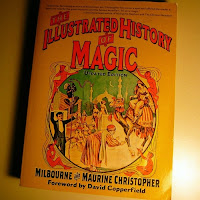
Ryan chose the Illustrated History of Magic book, while Michael picked Milton Babbitt's Phonemena CD.

illustrated history of magicmilton babbitt phonemena

Because both presents came at the same time, and Ryan and Michael are almost colleagues, I decided to compose a piece inspired by both objects. The Illustrated History of Magic suggested me to base the composition on the idea of transformation. In the piece, the transformation of a musical material into another is realized/improvised/decided live by the performers. From Milton Babbitt, I stole the series of twelve pivot notes used in the melody and harmony of Phonemena's first couple of bars.

I recorded the premiere performance on a minidisc (in Bien, Switzerland, on August 15th, 2008). The excellent performers were Yuji Noguchi, clarinets, and Vincent Daoud, saxophones. Here are the links to the recordings available on last.fm:

Transformations

bagict act 1 duo clarinet saxophone score
Follow the score when you listen to Act 1

In the score for Act 1, you can see musical figures connected with arrows. The arrows represent interpolation, or gradual transformation, from one musical figure to the next. The performers choose their own way of interpolating between the written musical phrases.

bagict act 3 clarinet saxophone score

In Act 3, the performers complete the score themselves. They write in all of the missing details and interpolation paths they want to play.

Performance in Canada

The Daoud/Noguchi duo was invited in the Fall of 2008 by the Edmonton Composers' Concert Society (now with a new name: Tonus Vivus Society). They gave this concert in Edmonton on October 25th, 2008. I was honored that they featured this composition in their programme Daoud/Noguchi Duo: …vers un théâtre du son…

...vers un théâtre du son... that's really a title that suits this duo: I wish you can listen to, and watch them soon!

Thursday, November 12, 2009

Workshops on FFT & Max

Max FFT Ateliers

FFT is a scary acronym for a scarier algorithm, the Fast Fourier Transform. Scary, but when it comes to sound processing, this is the door to go beyond the mirror of time domain. Sound is air in movement, atoms moving through space & time. When you push the door of the spectral domain (using the FFT algorithm), you access the frequencies that constitute the sound. In Shanghai Conservatory, on October 17th and 18th, I taught how to use the FFT in the software environment Max.

Max FFT Workshop Shanghai
October 18th, Shanghai Conservatory of Music

Free tools for spectral sound processing

Where the first day introduced the theory, the second day was a hands-on workshop. We spent quite some time on the distinction between time domain and spectral domain in Max/MSP (made easy by the [pfft~] object).

  • October 17th: topic introduction
    • waveforms (LP vinyl, tape)
    • time domain sound processing: speed & pitch link
    • analog granulation, digital granulation
    • spectral domain (spectrum, sonogram)
    • have fun with graphical sound transformations
  • October 18th: hands-on workshop
    • real-time (denoiser, "noiser", frequency shifting, pitch shifting)
    • freeze a sound
    • elastic time, automatic slicing

FFT Max Spectral Domain
The blackboard at the end of our morning session!

But most importantly, I wanted the students to be able to use spectral sound processing even if they would not become Max/MSP specialists. You can consider my Max MSP patches as free spectral processing tools: download the Max Runtime for free, and download the patches (link updated 01/12/2010). One student asked me how to record the output of the patches. Of course, if you own Max, you can modify the patches and add a sound file recorder. But before investing in Max, you can use a digital audio routing system, such as Soundflower, or Jack Audio, and any application that records audio (Quicktime Pro, Audacity, GarageBand, etc...)

Take care.

Tuesday, November 3, 2009

From Evian to Shanghai

evian shanghai

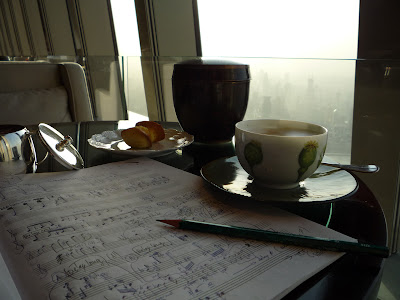
On October 19th, the day before my concert, I had a coffee at the Park Hyatt Hotel, at the 87th floor of the Shanghai World Financial Center.

I had taken my draft of Electroclarinet 1: I still had to clarify details of the score before the performance.

manuscript score Electroclarinet 1

In the summer of 1993, I spent 10 weeks as a worker in the Evian bottling plant.

It was fun to think that both the water and myself had made the trip from the Alps to the highest tower in China!

evian shanghai financial center hyatt Shanghai Financial Center & Jin Mao Tower

From the Financial Center (center), you can contemplate the top of the Jin Mao Tower (right).