Posts

Syhamo and Sy~

Image
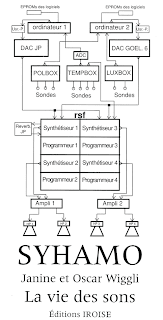
As I mentioned in an earlier post, sculptor Oscar Wiggli is passionate about sounds . This passion, plus his wife Janine's interest in electronics, led to the creation of the Syhamo, a synthesizer interacting with its environment, the kind of project that was not so common at the beginning of the 1980s. Last year, I had the great pleasure to see three students build and program a new version of the Syhamo: they called it Sy~ . Together, we visited the Wigglis in Switzerland - see Antonin Segault's report with pictures of the actual Syhamo . The visual dimension The original Syhamo creates music reacting to temperature, distance from users, a.o. How the Syhamo works: cover of the book Syhamo , published by Iroise . The Sy~ goes further by synthesizing visuals as well as sounds. Here are examples from the original beta version: Sy~ demo from Camille Henriot on Vimeo . Art & Glitch I was thrilled to learn that the three young professionals who created the Sy~ (Cam...

Oscar Wiggli, a sculptor and a composer

Image
On Friday, January 31st, director Claude Stadelmann presents his documentary about sculptor & composer Oscar Wiggli at the Théâtre de l'ABC in La Chaux-de-Fonds, Switzerland. The movie is shown at 6:15 p.m., followed by a concert of Wiggli's electroacoustic music at 8:30 ( more information ). Accompanying three outstanding multimedia students last year in Switzerland, I had the great pleasure to meet Oscar Wiggli and his wife Janine, as well as Claude Stadelmann. Next week, I'll tell you more about this visit and about the Syhamo . Sound lavis In this nice excerpt from the film , Oscar Wiggli is creating a sound lavis , i.e. a graphical creation in which he hears sound. Check out from 0:58 when he explains his work:

Tonight: homage to composer Christophe Bertrand

Image
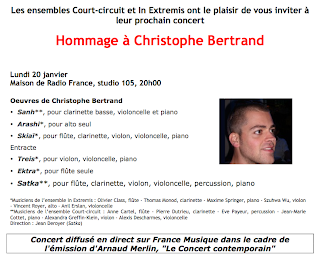
I met Christophe Bertrand at the Strasbourg conservatory : we both studied with composer Ivan Fedele . We also worked in the same ARES music school . Unfortunately, Christophe decided to leave this world in 2010. Tonight, you are invited to a concert of his beautiful and energetic music. Two contemporary classical music ensembles join forces for this unique event: In Extremis (co-founded by Christophe Bertrand) and Court-Circuit . Special thought for the In Extremis musicians: we shared intense musical time in the East of France, especially with violinist Szuhwa Wu, flutist Olivier Class, pianist Maxime Springer, and cellist Anil Eraslan. Concert at 8 p.m. Monday, January 20th, 2014 Studio 105, Radio France 116 avenue du Président Kennedy, 75016 Paris Porte B Free entrance. If you can't make it to the concert hall, listen to the live broadcast on France-Musique radio !

Usine presentation: software for music interaction

Image
Usine Hollyhock is made for musical interaction. In the panorama of music software, it lies somewhere in between Ableton Live & Max . Chief developer of Usine , Olivier Sens is invited in Brest as contrabass player, composer, and improviser, to perform with dancer and choreographer Dominique Jégou in festival Désordre (see also the Désordre poster ). They are also leading an improvisation workshop . Usine software presentation in Brest I'm delighted to announce that Olivier Sens accepted to present the Usine software at the Brest conservatory . You are invited! The interactive presentation happens on Monday, January 20th, at 6:30 p.m., room Bergot 206 (1, rue Chatellier), Brest (France) . Free entrance, plus bring your music instrument for a chance to experience novel musical interactions!

Blowing in a bottle: getting the frequencies

Image
Following up the conversion from video to sound file , let's go further in our guess at how much Rico Loop drinks. We are going to look at the nature of the sounds produced at each step of Rico Loop's video, using the signal's power spectrum. With Audacity , we get a power spectrum this way: select a portion of the sound in the menu Analyze , choose Plot Spectrum... To illustrate this post, I show, at the left of the power spectrum, the spectrogram with the sound snippet selected. First interesting pitch, at 0:19: We see that the pitch results from a very isolated peak in the spectrum. Here, the frequency is 512 Hz.   At 0:23, we read 417 Hz.     The three following peaks are: 350 Hz at 0:40, 290 Hz at 0:53, and 235 Hz at 1:02. Try you own analysis, for instance with Audacity, or with another sound analysis tool. Now, you should be able to find out how much Rico Loops drinks at each step.

Electroclarinet 5 - score

Image
Looking for the studio album? Visit www.electroclarinet.com Electroclarinet 5 is a composition for A clarinet & live electronics, written in homage to Igor Stravinsky . I completed the clarinet part on May 11th, 2013. The score is built around four (circled) motives directly inspired by Stravinsky's works: the Three Pieces for Clarinet solo and the Piano-Rag-Music . Electroclarinet 5: the clarinet part (click to enlarge) The performer plays around the score, following paths of her/his choice. Routes from one basic motif to another are either written (circle), or to be improvised (on black lines). When the clarinetist adventures outside the box (black arrows), s/he starts again from any place in the score (including from another place outside the box). The live electronics part uses advanced playing mode recognition to adapt sound processing to the clarinetist’s improvisation and interpretation. More on that later!

Blowing in a bottle: from youtube to sound file

Image
Remember: in the Fall, I invited you to solve a science of sound problem . In Rico Loop's video , the aim is to find out how much he drinks in between the moments when he blows different pitches in the bottle. A first step toward solving the problem consists in getting a sound file out of the youtube video ; then you will be ready to analyze the sound. Of course, you can use any kind of "youtube to mp3" software, but I want to show you a more general approach: using audio routing software . Although it requires a little more effort, you will then be able to record any audio coming out of any piece of software in your computer into a sound file. Here is the idea: Internal audio routing software The two open source options most used by musicians are: Jack , a flexible audio connection kit, available for Mac, Windows, Linux, and more operating systems! Soundflower , only available for Mac. There are plenty of resources online to learn how to use these tools, so I'm...