Monday, December 31, 2007

Working with Karlheinz Stockhausen - The art of performing
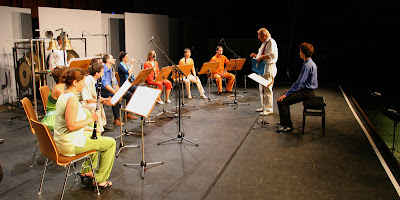
Dress rehearsal, August 2003.

Karlheinz Stockhausen Jean-Francois Charles Dress Rehearsal

As an homage to Karlheinz Stockhausen, I want to share with you a text I wrote in 2003, right after working with the composer. Several noteworthy aspects of his work have not been given much importance in the comments after his passing away. One of them is the importance of performance practice in his music. That's one of the memories we musicians will keep after having performed the world première and recorded Rechter Augenbrauentanz (The Dance of the Right Eyebrow).

The musicians

In the recording studio, August 2003.

Karlheinz Stockhausen Jean-Francois Charles Recording Studio

Impressions (2003)

Stockhausen is a master in performance practice. Admittedly, he is first and foremost a composer, but he also has a real gift for getting the best out of the interpreters who work with him. His commitment, experience and inner ear make his presence at rehearsals very effective.

Karlheinz Stockhausen CD 59

Rechter Augenbrauentanz is a composition for two clarinet voices, one bass clarinet voice, percussion, and synthesizer. We premièred the piece with six clarinets, two bass clarinets, percussion, and synthesizer, under Adrian Heger's conducting and Karlheinz Stockhausen's musical direction. For this piece lasting roughly half an hour, the ten days of rehearsals have been well occupied. Indeed, a correct performance of the piece must be played with a high synchronization between the different voices (it is obvious when we play Mozart's Gran Partita, but it is sometimes forgotten in what is called "contemporary classical music"). Moreover, Stockhausen pays much attention to the careful balance between the different voices. The balance between such high note of the first clarinets and such medium note clarinets of the seconds may require extensive testing, correcting, etc.

Like all scores from Stockhausen Verlag, the parts were of very high quality. Because it was a premiere, the composer wanted to check and correct some of the details: a rallentando, a dynamic marking, a pause or a breath were specified so that the music breathes, lives.

And always his interest for performance practice: he asks to play repeated notes repeated "as if we spoke," he emphasized the dance character of the piece ("a dance with ballet shoes, with no boots!") Anyone who has played his music knows that the music of Stockhausen is not reductible to a formula that unfolds. It is also much work closely with interpreters. This was once again the case with Rechter Augenbrauentanz. The good work environment is also important to note (importantly enough thanks to Suzanne Stephens) and we could feel that during the première concert, when each musician gave his best and we all took a real pleasure to play.

During the rehearsals (picture Heinz-Peter Linshalm.)

Jean-Francois Charles

Saturday, December 22, 2007

Nigritella nigra - Black Vanilla Music

Nigritella nigra

A composition for clarinet and string quartet

Nigritella nigra's first part (until 3'50'') consists in a chord which color changes through the use of microtones. This is a musical image of the flower's vanilla scent. The short central passage (until 4'15'') is a deforming mirror. After that comes a distorted retrograde of the first part. The concentration of energy in microtones in the first part is transformed in more extravert gestures in the second part. The flower Nigritella nigra has a strong character!

Avignon - Acanthes

I composed Nigritella nigra in 1998, for my first participation to the contemporary classical music center Centre Acanthes. Sofia Gubaidulina was the guest composer, while Viktor Suslin was responsible for the composition workshop. You are listening to the recording of the final concert, featuring musicians from the Orchestre Lyrique de Région Avignon-Provence, conducted by Sylvio Gualda:

  • Didier Breuque, clarinet
  • Delphine Avcioglu, violin
  • Marc Aidignan, violin
  • Michel Tiertant, viola
  • Alain Avcioglu, violoncello

The Centre Acanthes took place in the beautiful Chartreuse de Villeuneuve-lez-Avignon, and July was very sunny. The concert happened in a medieval church, open on the outside. As you can hear on the recording, the cicadas were enjoying the hot wheather!

My first "classical" composition

Nigritella nigra music score

As you can see on my 1998 manuscript, I used a very unconventional notation for microtones. Actually, at the time, I didn't even know the word microtone! So, I wrote a minus sign to mean "about 1/6 tone lower than the pitch", and a double minus to mean "about 1/3 tone lower."

Nigritella stiriaca by Olivier Gerbaud A beautiful Nigritella stiriaca, another species of orchid. Thanks to Olivier Gerbaud, who sent me this picture of his after listening to the music. Picture © Olivier Gerbaud.

Saturday, December 15, 2007

Bleu 1 - Remix your own version

Tonight, Saturday December 15th, I will diffuse Bleu 2 on the 30 speakers of the Hydra Loudspeaker Orchestra.

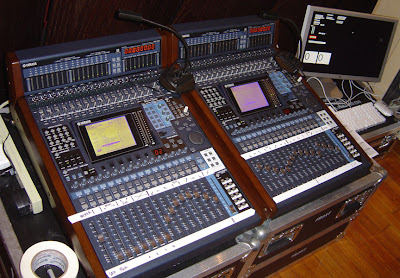
The mixing consoles driving the Hydra:

Hydra mixing consoles

As I already mentioned in my post Bleu 2 - electronic music - transcription, I composed the electronic music for Bleu 2 using as source material only Bleu 1, a set of three clarinet improvisations (well, clarinet in its extended meaning: bass clarinet, basset-horn, and contrabass clarinet). No other sample, nor synthesizers of any kind, but only sound processing of the original recordings.
My additional constraint has been to make Bleu 2 the same duration as Bleu 1.

Feel free to remix

Now, you can listen to Bleu 1, download the files, and make your own remix. You can also listen to each of the parts while looking at Miró's corresponding painting.

Creative Commons License These 3 improvised miniatures are licensed under a Creative Commons Attribution-Noncommercial-Share Alike 3.0 Unported License.

You can listen to Bleu 2, my "remix" of Bleu 1, from my post From Bleu 2 to Bleu 3, as well as here:

Thursday, December 6, 2007

60/60 - Join the Creation!

60/60 is an invitation to take part in my new composition project. I will compose 60 minutes of music, partly inspired by you and by a present you offer me.

Make a present - Receive a minute of music

The process is very simple:

  • You make me a present from my amazon wish list (see below)
  • I produce one minute of music
  • The music is dedicated to you (you may stay anonymous if you wish)
  • I e-mail the music to you (if you leave your e-mail address)
  • I tell the story about the gift and the composition on this blog
  • I make the music available here, too

Today, there are 60 gifts on my list. At the end of the project, I will have composed one hour of music.

Here is the list:

If no list appears above, you can find it also here: the 60/60 wish list.

FAQs

What kind of music will you produce?

The music will feature various ensembles: solo instruments, electronic music, chamber music, film music, MIDI instruments, improvisation, live electronics. If necessary, I will organize the rehearsals and recording session to get the minute of music recorded. I may also produce the music with electronic means.

How will I influence the music that you will write?

You will influence the music in several ways:

  • The present you choose will influence the music, from the instrumentation to the actual sounds
  • What you let me know about you, about why you choose this particular present, will have an influence
  • Let me know about your relation to music in general, that will also influence me. For instance, artists that you like, moments when you listen to music, the last concert you attended, if you play an instrument, etc.

Will you release a CD with the one-hour cycle?

Well, no one knows when the project will be finished, and if CDs will still exist then... In any case, I will make the music freely available on this blog.

What will be the copyright of the produced work?

The recorded music will be licensed under a Creative Commons Attribution-Noncommercial-Share Alike 3.0 Unported License. Creative Commons License

I will certainly keep the rights on the possible scores.

I want to participate, what shall I do?

  1. Choose an item in my wishlist, and buy it through amazon. I chose amazon, so you can be confident in the service. Choose what you like! The gift you choose will strongly influence the music I will compose, reflecting ultimately your own choice!
  2. In the comments when you buy on amazon, feel free to include your name, and to let me know why/how you choose the present. Include your e-mail if you want me to inform you when the new minute of music is produced.
  3. Let me know if you want to stay anonymous on the list of benefactors associated with the music. In that case, I will mention only your initials.

How much does it cost?

The items on the wish list range from $8.99 to $139.97 (today, 6.13 to 95.41 Euros) if you buy them new on amazon. You can also buy through 3rd party merchants, then the prices range from $1.86 to $64.59! (today, 1.27 to 44.03 Euros!) Feel free to buy a used item if you wish.

Have you already composed the music?

No! That's the point of this new project. I want to be influenced by the present, by what you tell me about you or about the present. I will compose the 60 minutes in the order I receive the presents, and that will be the final order for the whole cycle.

When will the project be finished?

One month after I receive the last of the 60 presents. Note that I have no idea about when the 60 presents will be gone.

What kind of presents are eligible?

Any present from my amazon wish list. You can buy it through amazon or through 3rd-party amazon merchants

Can I offer a used item?

Yes, you can do so from my amazon wish list.

How do I send the gift to you?

You don't have to send it. Amazon will send the gift to me automatically, as long as you purchase it from my wish list.

What happens if I pay for a present and you don't receive it?

I am very confident in amazon, especially when buying directly from them. I am also confident in amazon 3rd party merchants. If a problem were to happen, you would NOT have to buy it a second time! I will take care of the problem.

I can see less than 60 presents on the list, is it normal?

Yes. The presents already offered are taken out of the list, with a delay of up to several days.

Wednesday, December 5, 2007

Agate Lithophone Remix

I received a nice surprise last week. Georges, a multimedia artist from Savoie, France, reacted to my post Lithophone - Agate Music, and e-mailed me a remix of my example. Listen to his Agate composition.

Also, make sure you visit Georges' blog audiosource (in French), and maybe you will subscribe to his RSS feed. He declares his blog is about sounds, all sounds, the means of making them, recording them, composing with them, transporting them, making music or not with them.

Some posts with sounds and stories I like (you need to find the link to listen to the music):

Saturday, December 1, 2007

Plex - Basset-horn and Live Electronics

In fall 2002, still at Strasbourg Conservatory, I registered at the École nationale de musique du pays de Montbéliard (Montbéliard national music school). Ensemble New Flore had just invested in a new Apple Laptop (a Powerbook G4, 800 MHz, 756 Mo, at the time), and I wanted to learn interactive music with Max/MSP. I chose Montbéliard because of the composition faculty, Hans Tutschku and Jacopo Baboni Schilingi. Each other week, we met there during 2 intense days, with many great students. We were a creative and motivated community of young artists, including, for instance, Lorenzo "Lorbi" Bianchi and Daniele Segre Amar (now members of esc-crew). Nice music school in Montbéliard, isn't it?

montbeliard chateau ecole musique

My first composition with live electronics

Plex is a composition for solo instrument and live electronics. The live electronics may be played either by the soloist, or by a second performer. I performed the premiere on clarinet and live electronics in La Chaux-de-Fonds, Switzerland, on June 23rd, 2003.

The next performance took place on October 26th, 2003, in Weimar, Germany, during the festival "16. Tage neuer Musik". The Montbéliard Interactive Music Ensemble was invited, and we played a basset-horn version (I play a Buffet-Crampon model), with Hans Tutschku performing the live electronics part. We recorded a similar version in Le Palot, Montbéliard, during the afternoon of December 5th, 2003. Click play to listen:

Live extreme time stretching

In Plex, the soloist plays a 10-second musical phrase spread with live electronics over 6 minutes (these 10 seconds are played back 36 times slower without transposition.) To achieve this extreme time stretching, I programmed a special phase vocoder in Max/MSP. Additional spectral sound processing is applied, as shown on this schematic score:

Plex music score

Plex is a "live electronics" implementation of the concept of formula composition. I dedicated the basset-horn version to Karlheinz Stockhausen. Indeed, he and Suzanne Stephens have made a great contribution to the basset-horn litterature.