Posts

A Free Tutorial on Spectral Sound Processing Using Max/MSP and Jitter
Image
When I discovered electronic music during the Centre Acanthes 2000/Ircam , my favorite topic was real time sound processing in frequency domain. Hans Tutschku taught the wonders of AudioSculpt in Avignon, before Benjamin Thigpen taught Max/MSP in Helsinki. Now, the Computer Music Journal just published an article I wrote about spectral sound processing in real time and performance time ( whereas real-time treatments are applied on a live sound stream, performance-time treatments are transformations of sound files that are generated during a performance ). If you are interested in graphical sound synthesis, phase vocoder , and sonograms (or spectrograms) , I hope you will enjoy this tutorial. The great news is that you can download the article for free on the page of the Computer Music Journal, Issue 32, Volume 3 . Max/MSP/Jitter patches You can readily apply the described techniques in the development environment Max/MSP/Jitter . For a hands-on approach, make sure you download t...

15-16/60 - Bagict - Premiere in Switzerland

Image
Bagict is a duet for clarinet and saxophone. I am thrilled to dedicate this work to two friends, musicians, and scholars: Ryan Raul Banagale (have a look at amusicology.com ) and Michael Scott Cuthbert . Both of them are participants in the project 60/60. Because they joined the creation almost at the same time, I decided to pair them. The piece is called Bagict : hear a little magic and a little Babbitt (it's related to the presents each of them chose - more on that another time). Here is the current version of the first page of the score: Announcement We are very lucky: the work will be premiered next week by Vincent Daoud and Yuji Noguchi , wonderful performers of the ensemble Hic Et Nunc . An excerpt of the tasteful invitation I received - original version, of course: Freitag, 15. August 2008, ab 19.00 Uhr Théâtre de Poche, Brunngasse 1, 2502 Biel ( http://map.search.ch/biel-bienne/brunngasse-1 ) Programm: ab 19.00 Uhr     Eintreffen der Gäste 19.15...

Spectral Sound Processing: A Graphical Approach With Max/MSP/Jitter

Image
A sonogram (also called spectrogram ) represents graphically the distribution of energy of a sound through frequencies, in function of time. It may be funny or useful to transform the data graphically before resynthesizing the sound. This is made easy by a development environment like Max/MSP/Jitter, which allows to work in real time with sound and video. In this video , I show a few graphical treatments one can apply to a sonogram: If you wish to realize similar sound processing, here are Max/MSP/Jitter patches for spectral sound processing . Update: Computer Music Journal Tutorial on Graphical Spectral Sound Synthesis Read more explanations about this type of graphical sound synthesis in the free pdf article: A Tutorial on Spectral Sound Processing with Max/MSP & Jitter .

Arc-en-ciel cycle: a formula composition

Image
In 2001, I composed the Arc-en-ciel Formula . It is both a musical work for Bb clarinet and double bass, and a "musical formula" on which I have based the Arc-en-ciel cycle. Here is the score: Page 1: red, orange, yellow Page 2: green, blue, indigo, purple A cycle in seven parts The Arc-en-ciel cycle is based upon the above formula. At the time, I was very interested in the music of Karlheinz Stockhausen and in his technique of Formula Composition , as well as in Fractals (Formula Composition is an application of fractal thinking to musical composition). Red Magma for contrabass clarinet, stones, and live electronics (2003) Orange Wu jú sè for clarinet, percussion (5 chinese gongs), double bass, and dance (2002) Yellow Zygomatic for voice and live electronics (2005) Risorius for six voices (2005-2006) Green Rêver for singing dancer and dancing clarinetist (2004) Blue Aqua for solo double bass, aquaphon, clarinet, and live electronics (2004) Aqua Solo ...

Prisma - Summer 2008 Meeting

Image
I am just back from Montbéliard, France, where I took part in the July 2008 Prisma Meeting. Prisma is an international group of composers and researchers founded in 2001 at the initiative of Jacopo Baboni Schilingi . Prisma stands for " International Pedagogy and Research on Assisted Musical Systems ." I joined in 2003 at the invitation of Jacopo Baboni and Hans Tutschku . The group meet regularly to exchange and build musical knowledge. This time, the schedule looked like this (original untranslated program): Saturday 07/05 Générations musicales temps-réels de populations d'agents neuromimétiques ( Frédéric Voisin ) Rules for controlling Energy Profiles ( Orjan Sandred ) First steps towards Klangpilot3, a realtime system for learning sound synthesis ( Johannes Kretz ) Six hermeneutical models ( Jacopo Baboni Schilingi ) Sunday 07/06 PWGL - News (Mikael Laurson, Mika Kuuskankare , and Kilian Sprotte ) More PWGL News (Jacopo Baboni Schilingi and Orjan Sandr...

The seven clarinet recital

Image
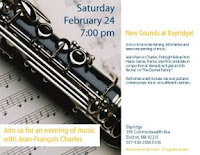
Yesterday, I went to Strasburg and had a coffee with Armand Angster, my former clarinet teacher. He is an expert at many clarinets, including bass and contrabass. The first instrument I learnt with him, after Bb clarinet, was the basset-horn, to play a Pascal Dusapin work during Festival Musica in 2000. Last year, I put together a recital program both artistically engaging and pedagogically interesting. I played it twice:   - Bayridge Residence and Cultural Center, Boston, February 24th, 2007   - Harvard University Hall, Cambridge, March 1st, 2007 Program Suite / Ed , Armand Angster - bass clarinet Petite Fleur , Sydney Bechet (1897-1959) - Bb clarinet Sieben Lieder der Tage , Karlheinz Stockhausen (1928-2007) - basset-horn Episodes , Gunther Schuller (1925-) - Bb clarinet Clarinet Quintet - Larghetto , Wolfgang Amadeus Mozart (1756-1791) - A clarinet Lina , Jean-François Charles - contrabass clarinet God bless the child , Billie Holiday (1915-1959)...

Ballade for clarinetist dancer - Video

Image
Do you remember of the announce of the Dancers' Dozen show ? Here is the video of Ballade : Ballade is one of the " 12 Études for Clarinetist Dancer ." As written in my original plan, the piece includes several references: First, the form of the piece is modeled after the classical verse form ballade . It is therefore made of 3 eight-line stanzas and a final envoi. The opening clarinet phrase could be heard (and analyzed) as a variation on the solo overtures of Debussy’s “Prélude à l’après-midi d’un faune”, and Stravinsky’s “Le Sacre du Printemps.” Similarly to the music, the choreography makes use of three sources of inspiration. During the first part ("stanza"), the dance builds upon movements from Nijinsky’s Prélude à l’après- midi d’un faune . In the second part, music and movement become more earthy. The dance is developed mainly after a cell from Nijinsky’s Rite of Spring . In the third part, I use gestures referencing François Villon ’s Ballade d...