I got interested in Anna Teresa de Keersmaeker's choreographic work when I was a student at Strasbourg Conservatory. Around 2003, Marie-Claude Ségard, head of the conservatory, organized a visit to the dance school lead by the choreographer : P.A.R.T.S, in Brussels - I was invited and it was a great experience. At the same time, I and a couple of friends were playing Thierry De Mey's music: we performed a Maximalist! program during the international contemporary music festival Musica.
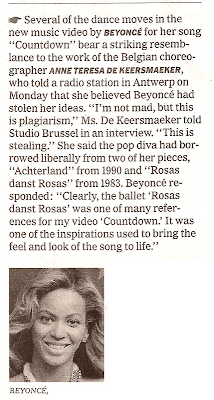
You can imagine my surprise when, on October 27th, aboard the Boston-NYC Chinatown bus, I came upon the following note in the People section of the New York Times:
I must confess that, among all of the new music I've been listening to this year, Beyoncé's album 4
(sponsored link) ranks at the very top. Anchored in the tradition, she is also innovating, but as importantly, the production quality is up to high standards.
I was glad to read that Beyoncé completely acknowledges having borrowed from this choreographer, a famous one in the European modern dance community. If you haven't seen it yet, watch this split screen showing Beyoncé's work on the left, Anna Teresa de Keersmaeker's one on the right :
As you can see, the "sampling" tradition in music has been extended to dance here, and even to Thierry De Mey's original ideas for sets and film making. Beyoncé did not credit de Keersmaeker, but there is little doubt lawyers are gonna find an arrangement: hip hop artists have been crediting music samples for quite some time now. For the record, you'll find below Beyoncé's original video Countdown:
During Expo '74 in Brooklyn, New-York, it was great to meet again with composer Francisco Colasanto. But Francisco is much more than a composer, starting with being currently the technical coordinator of the Mexican Center for Music and Sonic Arts (CMMAS) .
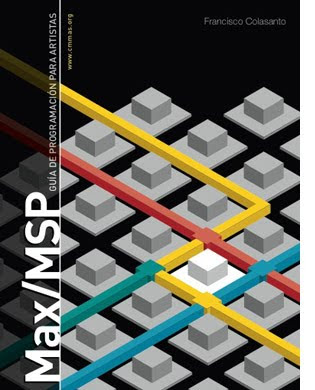
If you are interested in programming interactive music, especially in the software package Max MSP, I encourage you to check out his book: Max/MSP: programming guide for artists (www.maxmsptutorial.com). This first volume helps artists getting started with visual programming in the Max MSP environment. On the book's web site, you will find all of the "patches"
illustrating the tutorials.
Francisco is currently working on the second volume, an e-book including tutorial videos: it will be one more great addition to the electronic music litterature.
Finally, discover on the following video Francisco Colasanto's work Baile for contrabass clarinet and live electronics, as performed by clarinetist Marco Mazzini: