Monday, October 27, 2008

Freeze a sound with Max/MSP/Jitter
Version FrancaiseIn April 2008, I was invited by composers Eric Chasalow and Maxwell Dulaney to give a 2-day seminar on spectral sound processing techniques at Brandeis University Music Department.

A topic the music students particularly enjoyed was the frozen sound, the audio equivalent of the cinematic "freeze frame shot". I taught the nuts and bold of the real-time stochastic spectral freeze technique (the stochastic component is aimed at breaking the ice - with the audience).

On this video, discover 5 variations on a Max/MSP/Jitter freeze tool:

Free downloads

frozen beauty

Syllabus

The program for just two 3-hour workshops was quite ambitious!

April 14th

  • Overview of the topic: “Spectral processing, or having fun with graphics and sound.”
    All students and faculty members are welcome (not only to the computer music specialists).
  • Spectral explorations 1
    Sonogram. Fast Fourier Transform (FFT). Recording spectral data into Jitter matrices. Frame to frame playback.
  • Introduction to Jitter
    Matrices, filters, expressions.
  • Spectral explorations 2
    Phase vocoders: Max/MSP version versus Max/MSP/Jitter version. Variable-speed playback (time stretching, time compression).

Waiting for next session

Assignment! Play with pictures, spectrograms, vocoders, [pfft~].

April 28th

  • Spectral explorations 3
    Real-time spectral processing with Max/MSP. Denoiser, amplitude compression, frequency shifting, pitch shifting.
  • Spectral explorations 4
    Back to our Max/MSP/Jitter phase vocoder. Blurry playback.
  • Spectral explorations 5
    Real-time spectral processing with Max/MSP and Jitter. Real-time Freeze.

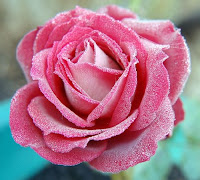
Rose Picture "Frozen Beauty" CC License by freebird4

Monday, October 20, 2008

Viola Recording Session - Garth Knox

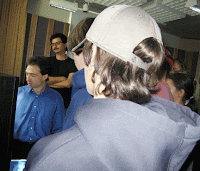
Version FrancaiseOne week ago, on Monday, October 13th, the outstanding violist Garth Knox was the guest of the Harvard Group for New Music.

Repertoire survey

First, he talked about the history of the viola and its techniques, while constantly playing examples. Quite a great survey of the viola repertoire: Bach, Mozart, Beethoven, Brahms, Schumann, Berlioz (did you know that Paganini asked Berlioz to write for the viola?), Hindemith, Bartok, Stravinsky, Ligeti, Xenakis, James Dillan, Murail, Grisey, Kurtag, Berio, and Sciarrino. Finally, he presented eight fun études: Viola Spaces. He composed them to help teach contemporary techniques.

Recording session

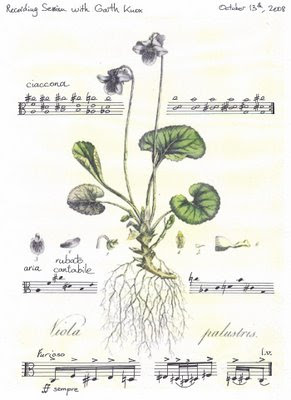
In the afternoon, we had a chance to record Garth Knox in the Huseac Studios: Edgar Barroso and myself seized the unique opportunity. Here is the score I had written for the occasion:

score viola palustris lapalu recording

I also asked him to play in reaction to these four propositions:

Play the spectrum of this flower
Viola palustris
Violet Picture GNU license by fi:Käyttäjä:kompak
Play the simplicity of this flower
Viola palustris
Violet Picture CC license by Manuel M. Ramos
Play the rhythm of this flower
Viola palustris
Violet Picture GNU license by Kristian Peters
Play the entourage of this flower
Viola palustris
Violet picture CC license by MiikaS

The session was fast-paced and went very well. Garth Knox shared with a communicating enthusiasm his creativity and experience. Thanks to Professor Hans Tutschku who helped us set up the microphones and ProTools session in advance.

Concert in February 2009

This event took place as a first meeting before Garth Knox comes back for a concert on Saturday, February 14th, 2009 in Cambridge. Several new works will be composed for him. My contribution will be a work for viola and live electronics, and the title will be: Lapalu.

Tuesday, October 14, 2008

Young Composers

Jean-Francois Charles Edgar Barroso Harvard Huseac

Version FrancaiseOn Friday, Edgar Barroso and myself received seven 13-year old composers in the Huseac Studios. We let them know about some ways we've been composing. And they described their own work in electronic music: they have been using Apple GarageBand to compose, after recording their own sound material. That sounds like a great introduction to composition.

All the best to the professor and the students: you share an exciting project! I hope we'll get to hear your works!

Picture and organization by Lesley Bannatyne.

Thursday, October 9, 2008

Zygomatic - Laughter Music

Version FrancaiseZygomatic is a composition for voice and live electronics. It is part of the Arc-en-ciel cycle. The premiere took place on June 17th, 2005, in Le Palot, Montbéliard, France. The wonderful singer was Isabelle Jost, while I was performing the live electronics. Listen to the concert recording here (click the play button) or there: Zygomatic on last.fm (download is also possible).

A personalized sonorous score

During the first part of the recording, you will hear only the voice, no electronic music. This is normal! The live electronics generate in real time a personalized sonorous score. The score is sonorous: the singer hears the score (a kind of electronic music) thanks to a wireless in-ear monitor. The score is personalized: it is generated live by transformations of the first 10 seconds of the voice part.

But what does it mean, to interpret a sonorous score? Here is the text I wrote in the score, in 2005: "Interpréter une partition sonore, c’est orienter son écoute dans l’espace de la partition et chanter en imitation. C’est choisir un point d’écoute et le présenter sous forme chantée au public." A literal translation goes something like: "To interpret a sonorous score is to orient one's listening in the score space and to sing in imitation. It is to choose a listening point and to present it to the public in a sung form."

Zygomatic Music Study

The second part is a presentation of the piece itself (in French in this version).
In the third part, you get to hear both the singer and the sonorous score itself. It is generated in real time using Max/MSP and Jitter. During the premiere performance, the Max patch was also projected at this point, showing different processes and sonograms. On the right, see a preliminary study for the live electronics, from October 2004.

Music and Laughter

One of the famous laughters, among those recorded in a musical context, is featured on The Okeh Laughing Record. Click on the link to listen to the recording on The Internet Archive and read comments & information. It was recorded in 1923, far before another famous example: I Love to Laugh.

Saturday, October 4, 2008

Demolicious Performance - Music, Poetry & Video

Version FrancaiseAfter four seasons, Demolicious is calling it a day.

I have been invited to perform for the occasion at Pierre Menard Gallery in Harvard Square (10 Arrow Street).

Pierre Menard GalleryThe performance takes place this Sunday, Oct. 5 at 3pm.

Program and Artists

I will play Lina for contrabass clarinet and give an interactive presentation of my current work with live electronics. I look forward to meeting the great artists who will be there tomorrow. And of course, to seeing you there, too!