Saturday, November 27, 2010

Bleu 2 in Poland

I first met Marcin Wierzbicki in Cracovie in 2000 during the Acanthes / Ircam summer academy. He is a great composer with a deep knowledge of acoustics, electronic music, interactive music, spectral sound processing, and more!

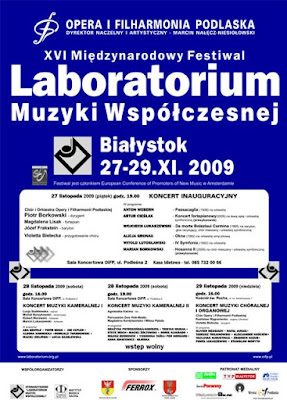
Poster Festival Laboratorium Bialystok

Tonight, he is spatializing my composition Bleu 2 (electronic music) during the Laboratory Festival in Bialystok. In case you're in the area, make sure to attend the concert: you'll get to hear Marcin's brand new composition Transient Music for computer.

Wednesday, November 17, 2010

Clickers & quality of teaching

Systèmes réponse instantanée enseignement qualité

Yesterday, Jacques Steinberg wrote an article about the use of "clickers" in education: More Professors Give Out Hand-Held Devices to Monitor Students and Engage Them. I'm glad to read about this pedagogical tool in the Times, but it's important to mention that the benefits of the clickers, when backed by a great pedagogical approach, go far beyond the article description.

In The Physics of Music & Sound, a course from the General Education program at Harvard, the clickers are part of the numerous tools Pr. Eric Heller uses to engage the students in a deeper level of reflection (I was a Head Teaching Fellow for the class in the Spring). He uses them to make the class as participatory as possible. Discussions, live demonstrations of experiments, student demonstration of voice and instruments, computer experiments that you can also easily do, peer instruction and PRS "clicker” participation are all part of the experience.

In Pr. Heller's class, peer instruction (a fundamental aspect of learning as advocated by Pr. Eric Mazur at Harvard) is systematically combined to clicker questions. A "good question" for Pr. Heller is not always be a question where everyone answers "correctly", but rather a question with a split answer 33 %, 33%, 33% over three choices: that makes for lots of interesting discussions. And discussions sometimes really drive scientific research! Taking attendance may be useful, but should remain a side-effect!

turning technologies clicker apps
Many students don't buy clickers, but a one-year license to use their phone instead.

After reading the article, have a look at the NY Times blog reactions. Pr. Bill Goffe gives there three interesting links.

Using clickers to improve the learning quality is an art that educators have to learn!

Monday, November 15, 2010

Duke Ellington's 1932 Rhapsody in Blue

Duke Ellington Rhapsody in Blue

Last year, I invited you to the concert of the Dudley House Jazz Bands, during which we performed three versions of George Gershwin's Rhapsody in Blue.

Here is the live recording of Duke Ellington's 1932 arrangement (also on youtube):

Featuring:

  • Piano & musical research: Ryan Raul Bañagale
  • Clarinet intro & musical direction: Jean-François Charles
  • Soprano & tenor saxs: Eric Diebold
  • Alto saxs: Kimberly August, Jillian DeMair & Richa Gawande
  • Baritone sax: Aaron Silberstein
  • Trumpets: Evan Biela, Gary Smiley, Chris Zuidema & Stephen Furqueron
  • Trombones: Ethan Fenn, Rob Cautillo, Cara Takakjian & Tim Fung
  • Guitar: Jonathan Buonocore
  • Bass: Andres Enrique
  • Drums: Max Behrens

Update after L's comment.
CDs and mp3s of the two other versions we played during the concert: Billy Strayhorn's Rhapsody in Blue (Duke Ellington's band) and Bill Putnam's Rhapsody in Blue (Stan Kenton's band).

Monday, November 8, 2010

Music on a Park Bench

Musique banc public

On May 12th, 2008, I played clarinet in a student orchestra, in Harvard Pforzheimer House. I was thrilled to take part in a recording session for a new movie project - more than a movie: a musical! - by a team of Harvard undergraduates. Writer & director Damien Chazelle '08 and composer Justin Hurwitz '07 were leading what was surely one of their first recording session with an orchestra.

Since then, the project went a long way, and the feature musical Guy and Madeline on a Park Bench was just released in New York this week-end: get your tickets now on Cinema Village. Make sure you watch it when it comes close to your place!

Guy Madeline Poster 1st week

Damien Chazelle was a Harvard Artist Development Fellow.

Monday, November 1, 2010

Clarinet multiphonics in Electroclarinet 1

Clarinette multiphoniques Electroclarinet 1

A clarinetist recently asked me some help before performing my composition Electroclarinet 1, for Bb clarinet and live electronics. I've been thrilled to help her, and at this occasion, I engraved the multiphonics with the correct fingerings:

clarinet split tones
These are split tones, played with regular fingerings. Low & higher harmonic region refer to the amount and relative frequencies of the partials present in the sound, similarly to what Xenakis uses in his composition Charisma.Timbre trill with low F key.
 

clarinet multiphonics
Multiphonics with specified fingerings.
 

clarinet diphonic
Soft diphonic.
 

clarinet trill multiphonics
Harmonic note over tremolo. For the high note, it is normal to hear a slight pitch variation, not written here.
 

clarinet multiphonic fingering
With given fingering.
 

clarinet multiphonics underblowing
"Underblown" multiphonics. Notes with fermatas are played with regular fingerings. Eighth notes are played with "regular" open fingerings, as indicated.
 

clarinet split tone
Regular split tone, play with full sound spectrum.
 

Have a look at the multiphonics in their original notation: they figure in the music manuscript. Also, make sure you listen to the live recording of Electroclarinet 1's premiere!