Monday, September 28, 2009

Meet Prisma in Shanghai

prisma meeting shanghai Prisma Shanghai

Prisma is a group of composers and researchers dedicated to International Pedagogy and Research on Assisted Musical Systems. The next Prisma event is happening in Shanghai Conservatory as part of the 2009 Shanghai International Electroacoustic Music Week. From October 16th to 26th, you can attend workshops (including hands-on instruction by the best specialists of PWGL), a series of conferences, and concerts.
I have been invited with the following musicians and researchers:

  • Hans Tutschku, composer, Harvard University (USA)
  • Jacopo Baboni-Schilingi, composer, Conservatory of Montbeliard (France)
  • Orjan Sandred, composer, researcher, University of Manitoba (Canada)
  • Johannes Kretz, composer, researcher, University of Vienna (Austria)
  • Mikael Laurson, researcher, Sibelius Academy, Helsinki (Finland)
  • Carlos Caires, composer, Escola Superior de Música de Lisboa and CITAR - Research Center for Science and Technology in Art (Portugal)
  • Mika Kuuskankare, researcher, composer, Center for Music and Technology, Sibelius Academy, Helsinki (Finland)

I'm looking forward to discovering the conservatory's facilities, and meeting both the students and the guest Chinese composers and researchers:

  • Feng Yin, researcher, Xiamen University, Institute of artificial intelligence, Group Art and Mind Lab
  • Jian Liu, Wuhan Conservatory, Director of the Computer Music Departement
  • Wing-wing Lee, Hong Kong Academy for Performing Arts, Head of Sound Design & Music Recording Department

Check out www.prisma-shanghai.org for more information.

What I'll be teaching

Here are some of the topics I proposed to address in my workshops. If you come, you can be certain that the content will be tailored to fit your needs!

Shanghai Conservatory - 4 full days: October 16th to 19th.

What I'll be presenting

A few ideas I plan to incorporate in my intervention during the Prisma symposium:

  • Why you need Max 5: have fun with graphical sound processing in real time
  • Why you do not need Max 5: compose and perform a piece with live electronics
  • Why you need Max 5: to teach and to learn
  • What you do not need Max 5: flexibility is key

Shanghai Conservatory - October 20th, 2:30 to 3:45 pm

What I'll be performing

The organizer of the 2009 Shanghai International Electroacoustic Music Week invited me to perform a piece for clarinet and live electronics. Rather than playing an old piece such as Plex, I have been composing a new piece that will be entitled Electroclarinet 1.

Electroacoustic Music Center Shanghai - October 20th, 7:30pm

Electroclarinet 1 - Program notes

A couple of weeks ago, I wrote program notes that I kept fairly general given that the piece wasn't written yet... I hope I'll meet the requirements.

In Electroclarinet 1, Jean-François Charles presents his electronically enhanced clarinet. This exploration and combination of different sonic characters is also a reflection on the expressive power of electro-acoustic instruments.
Jean-François Charles belongs to the long tradition of composers who are also performers and instrument developers. He is fascinated by both the richness of acoustic instrument sounds and the ever-expanding possibilities offered by live electronics. In Electroclarinet 1, he shows that the expressivity so tactile in acoustical music (solos, chamber music, orchestra) may be just as palpable with new electronic sounds.

Tuesday, September 15, 2009

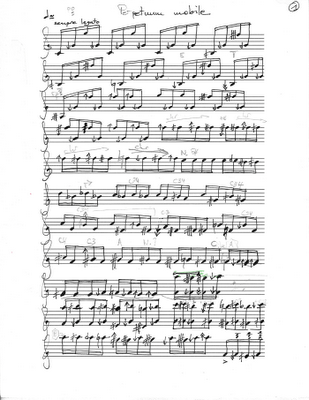
Perpetuum mobile - meditation for dancing clarinetist

Perpetuum mobile clarinet solo page 1Perpetuum mobile clarinet solo page 2
Perpetuum mobile manuscript

Above is the manuscript of Perpetuum mobile, the second part of PPP for dancing clarinetist.

The music is to be performed legato sempre using circular breathing. When the clarinetist reaches the end, s/he circles back to the top, and can play it for as long as desired.

The dance movement is notated in Labanotation / Kinetography Laban (just one side is notated). It should be looped as well. The movement should be very slow, inspired by the Butoh art of dancing.


Perpetuum mobile starts at 2:25 in the PPP video

This section of PPP is more minimalist than Stockhausen's In Freundschaft, Harlekin, Tanze Luzefa, and other innovative pieces created by Suzanne Stephens. If you're a clarinet player, I hope you enjoy performing it!

Friday, September 4, 2009

Robert Levin is a true music lover

Robert Levin

This fall of 2009, I am fortunate to be appointed head teaching fellow for Harvard's core course B-54: Chamber Music From Mozart to Ravel, taught by Robert Levin (Curriculum Vitae on Harvard Music Department's web site) (there is a shorter biography on wikipedia).

Attending a lecture by Robert Levin is a great experience. He believes that anyone can have fun listening to great music, and he is very talented to communicate his fascination for music. Whether you never listened to classical music in your life, or you are an accomplished musician, you will hear music differently after listening to him.

For this year's edition of the course, he chose to spend some time with the following pieces of chamber music:

  • Joseph Haydn String Quartet in E-flat major, Op. 33/2, Hob. III:38 (“Joke”)
  • Wolfgang Amadeus Mozart 25. Sonate in A: KV 256 for violin and piano
  • Franz Schubert Trio in E-flat Major, D 929 op. 100
  • Felix Mendelssohn Bartholdy Second String Quartet
  • Robert Schumann Phantasiestücke Op. 73 for clarinet and piano
  • Johannes Brahms Sextett Nr. 2, Op. 36
  • Antonin Dvorak Quintet for 2 violins, viola, cello, and double bass, Op. 97
  • Claude Debussy Sonate pour Violoncelle et Piano
  • Maurice Ravel Histoires naturelles (voice & piano)

Well, today, he spoke a lot about Bach and the Beatles!

Robert Levin
Picture copyright Kris Snibbe/Harvard News Office - See this 2006 article in the Harvard Gazette

Robert Levin is an improvisor, and a rebel

Derek Bailey invited Robert Levin in his documentary On the edge, part 1 (first broadcast February 2, 1992 on the BBC). Although you could look at a short excerp on youtube (Robert Levin talks about improvisation), I strongly encourage you to watch the full 13 minutes on ubu: On the edge part 1. Robert Levin plays piano and is interviewed from 07:00 to 20:00. Enjoy!