Thursday, February 24, 2011

Harvard Music Library in the news
Harvard Music library

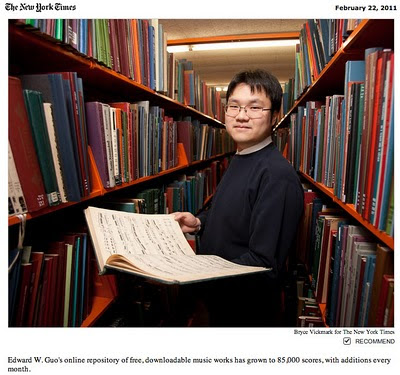
This is the untold story of this week's New York Times article on the International Music Score Library Project. It features a prominent picture of the IMSLP founder, with the following caption: Edward W. Guo's online repository of free, downloadable music works has grown to 85,000 scores, with additions every month.

guo harvard music library

But what the journalists don't mention is that Mr. Guo was photographed in another beautiful score library: the Harvard Music Department's Loeb Music Library. And today, there are still more music scores in this library than in the IMSL (more than 168,000).

The IMSL is very useful to find public domain scores. But make sure you visit Harvard's Digital Scores & Libretti: you will find treasures there.


An excerpt of Mozart's Magic Flute overture.

To get the news on newly digitized scores, read the Loeb Music Library's blog...

Wednesday, February 16, 2011

Sound & digital art: guest talk

son numerique

This Thursday, February 17th, I'm talking in the Cafés numériques (digital cafés) series. My talk is entitled Le son et l'art numérique (sound & digital art - link to more information on the series)

I'm focusing on two topics:

What does it mean to talk about digital sound and analog sound?

  • what sound is
  • short history of audio recording technology
  • LP record versus CD
  • why artists today (like Jay-Z & Kanye West) are still recording & mixing with analog gear in studios such as Peter Gabriel's great place
  • advantages of digital technology... including the fact that almost anybody can play with sounds today!
record groove
Inside a LP record groove: picture by Chris Supranowitz

Do we compose differently with digital technology?

Well, I'm answering the question in a very applied way: as part of the talk, I'm performing the première of Electroclarinet 3, a new composition for basset-horn & live electronics.

Sunday, February 13, 2011

Local news

These days, local means France: have a look at the article Les Échos recently featured on Harvard and the Harvard Club de France.

But even more local means the Belfort-Montbéliard area, between Lyon and Strasbourg. Tomorrow Monday, I am the guest of Maïté's Pause Café on France Bleu Belfort Montbéliard at 1:30 p.m. That should be fun. But I doubt this program will be streamed, sorry!

Thursday, February 10, 2011

New course: Introduction to electronic music

introduction electronic music

On Tuesday, I started teaching an introduction to electronic music at the conservatory of Montbéliard. I designed a hands-on course, during which the teenagers hear and analyze a few major works from the 20th century, learn about the nature of sound and its processing inside a computer, record sounds and compose original works. The students are musicians (they play piano, trumpet, bassoon, etc.), but it's the first time they're hearing about Musique concrète, Karlheinz Stockhausen, or DAW.

The students must be able to work at home, so I chose to introduce two free cross-platform tools:

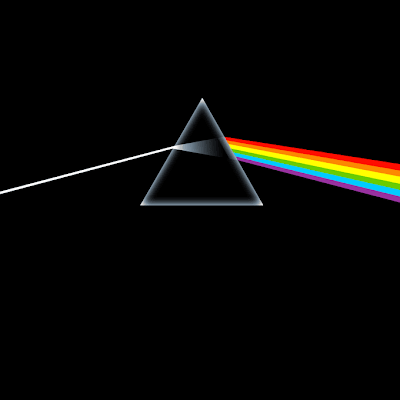
dark side of the moon cover
Pink Floyd's Dark Side of the Moon:
the students are analyzing parts of this masterpiece, and learning a lot about electronic music.

The titles of the course plan:

Introduction to electronic music

  • Part 1: Pierre Schaeffer & the railways music
    editing techniques from the era of magnetic tape
  • Part 2: Pink Floyd & the dark side of the moon
    spectrum, filtering, writing symbolic scores
  • Part 3: Lady Gaga & her poker game
    focus on the voice instrument, filtering, sonic personalities
  • Part 4: Stockhausen & the song of the youths
    mixing voice, electronic sounds, instruments & more
  • Part 5: Final projects
    finalizing a composition