Wednesday, July 28, 2010

Acquainted with the night - live recording

Acquainted with the night

In March, I announced the creation concert "Acquainted with the night", during which we premièred five new musical compositions on Robert Frost's poem. I just posted the live recording. It features singer Michael Barrett (I was playing the basset-horn and live electronics).

<a href="http://jfcharles.bandcamp.com/track/acquainted-with-the-night">Acquainted with the night by Jean-Francois Charles</a>

Thursday, July 22, 2010

Clarinet multiphonics

Multiphoniques clarinette

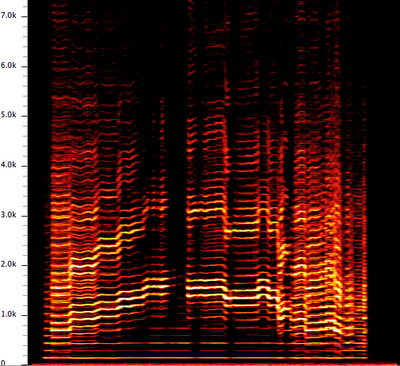
On July 4th at Ircam in Paris, during the July 2010 Prisma meeting, I included in my presentation a few sonograms of clarinet "multiphonic" sounds, these sounds in which one can hear more than one pitch at the same time.

Sonograms

I recorded these rough multiphonic clarinet sounds in Cambridge on Friday, June 19th, 2010. The four sound files are available on freesound: Clarinet multiphonics.

clarinet multiphonic sonogram

bb-clarinet-01-split.aif

This is the sonogram of a rich multiphonic sound, commonly called a split tone. Here, it's played on a low fingered E (concert D), the lowest note of the Bb clarinet. The clarinet player can emphasize different harmonic regions. This is what Iannis Xenakis is calling for in his 1971 composition Charisma for clarinet and cello, when he writes Harm. Zone I, II, III, and IV.
To achieve this effect, the clarinet player modulates the air pressure and changes the shape of his/her vocal cavities. We see on the sonogram that this selective reinforcement of harmonic regions consists in moving two formants.

clarinet harmonics sonogram
bb-clarinet-02-isolate.aif

This second sonogram shows that on the same low E fingering, the clarinetist can choose which partials sound. This is the basic technique for producing notes in different registers. In normal clarinet playing, the selection of the register is done with the help of keys and fingerings, but the control of the air column and vocal track shape remains very important.

clarinet multiple sound sonogram
bb-clarinet-03-series.aif

By using special fingerings, one can transform a unique clarinet into a dual sound generator. E. Michael Richards explains the phenomenon very well. The sonogram above corresponds to the example #2 on his page Clarinet multiple sounds - you'll find there the score and fingerings.

clarinet multiphonic sound
bb-clarinet-04-octave.aif

As you may know, the clarinet's bore is mostly cylindrical, and that results in very weak even harmonics in the sound. For instance, the octave is almost absent from the analysis of a clarinet sound. But if you find a special multiphonic fingering giving you a fundamental and its octave, you can really change the timbre of the instrument. The last sonogram illustrates such a sound, here with a fade from a note to its octave.

Clarinet acoustics

Here are a few good sources on the acoustics of the clarinet.

  1. a reference that Pr Heller used this year as a reading in his Harvard course The Physics of Music & SoundClarinet acoustics from the University New South Wales in Sidney.
  2. excerpts from Pr E. Michael Richards’s excellent book The clarinet of the 21st century.
  3. an important study of multiphonic sounds by French clarinetist Alain Sève:

And let me introduce two friends of mine. First, the excellent Michael Norsworthy, Boston-based clarinetist. In the following video, he demonstrates four types of multiphonics. By the way, he calls "overblowing" multiphonics the ones I call split tones.

Second, it looks like clarinetist Adam Berkowitz is going to talk about multiphonics in his upcoming book Four Extended Techniques for Clarinet: A Practical Guide. I'm looking forward to the publication...

Friday, July 2, 2010

Prisma meeting - Summer 2010

Prisma composers 2010

Prisma stands for International Pedagogy and Research on Assisted Musical Systems. This summer, this group of composers, musicians, and software developers is meeting from July 2nd to 5th at Ircam in Paris.

Participants include:

IMG_6616
Ircam in the back of the Stravinsky fountain.

My talk this year: the Physics of Music & Sound

Last year, my talk was entitled Ableton Live for Live Electronics. I compared Ableton Live to Max 5, highlighting what was easier to realize using one or the other piece of software, in the context of composing for classical instruments and live electronic music. I also talked about Logic Pro, since most of the "live electronic music" capabilities used by many composers are also implemented inside Logic Pro's environment.

This year, I'm going to present several dimensions of the Harvard course The Physics of Music & Sound:

  • Max 5 patches I developed for the course
    a generator of partials, a model of a siren, and an application to play with and understand better formants
  • Inharmonicity of low piano strings
    a homework assignment in which students have to determine which piano is the biggest through a spectral analysis of low note samples
  • Clarinet multiphonics
    I've been working on a new homework assignment studying clarinet multiphonic and subtone sounds. I'll give a glimpse of that work-in-progress.