Wednesday, May 26, 2010

The 6 a.m. Dixie gig

early gig

Tomorrow is graduation day at Harvard. Last year, I was an usher in Sanders Theater. This year, I'm in for a more musical job. With friends, we're playing Dixie music at 6:30 a.m. during an early walk to Memorial Church, after a 6 a.m. Champagne breakfast. Looking forward to that!

Sunday, May 16, 2010

My first ballet class

As you may know, I've been interested in the relations between music and dance for a few years. My interest started maybe with the study of Karlheinz Stockhausen's operas and compositions for moving musicians. When I took part in the Stockhausen courses in the summer of 2001, I attended Markus Stockhausen's yoga introduction, every day at 7am. That was quite a fun experience, and I remember that composer Flo Menezes attended, too.

It took me time before I dare try ballet: I took my first beginning class at the Harvard Dance Center in February 2009. My teacher was Margot Parsons, whose first words to me were "Left hand on the barre"!


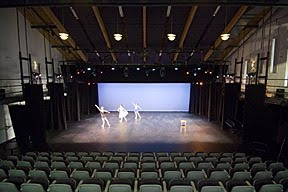
The Harvard Dance Center's nice Studio 1, in concert configuration.

Margot Parsons co-founded the Dance Visions company; you can watch her interview on To the pointe TV. Thank you Margot for accepting me and teaching me the basics of what a ballet class is!

Wednesday, May 12, 2010

Neue Vocalsolisten Stuttgart perform Risorius

Neue Vocalsolisten Stuttgart Risorius

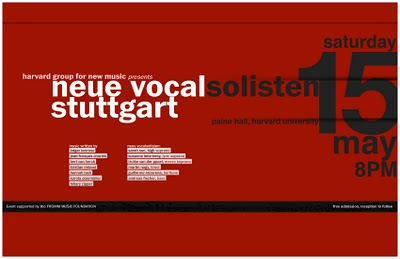
You are invited to the last concert of the 2009-2010 HGNM season. Concert is Saturday, May 15th, 8pm, in Harvard Music Department's Paine Hall. The Neue Vocalsolisten Stuttgart are performing seven new compositions, including my work Risorius, and new works by my colleagues:

Program notes

I composed Risorius in 2005-2006 as the third part of the cycle Arc-en-ciel. Risorius is a facial muscle, which pulls the corners of the mouth laterally. In 2004, I started exploring the musical potential of laughter with Zygomatic, a composition for voice & live electronics. Both works are part of a long tradition of compositions using laughter, such as Wolfgang Amadeus Mozart's Magic Flute, the 1923 OKeh Laughing Record, or Karlheinz Stockhausen's Lucifer's Fury.
I hope you will enjoy the piece until the concluding fun(eral) lament.
Risorius is dedicated to Malo.

Monday, May 10, 2010

Coeur brisé - In memoriam M.J. - the video

Coeur brisé vidéo

This has been one of my main projects since January. I've been fortunate to have been helped by many friends (list at the end of the video). Thank you all, from the bottom of my heart.

Coeur brisé on youtube

Thursday, May 6, 2010

Seven Harvard Talks

Sept conferences Harvard

Last week, my dissertation colloquium was my last and seventh talk in five years at the Harvard Music Departement. The piece most of the audience talked to me after the colloquium has been PPP:

PPP slide
One of the presentation slides from my dissertation colloquium.

The six previous talks were:

  1. Fall 2005 Incoming PhD student, I presented some of my compositions in the fields of chamber music, dance & music, and interaction with live electronics. Violinist and composer Hillary Zipper joined me very friendly and we performed excerpts from Plex, a composition for violin and live electronics.
  2. Fall 2006 I was blessed to have the Ying string quartet for this talk. We played together a preview of the two first movements of Carlina acaulis for contrabass clarinet and string quartet. I presented my work in progress, including the drafts and ideas for the third movement, that wasn't completed at the time.
  3. Fall 2007 During the musicologists' colloquium series, I presented my explorations of granular synthesis and spectral sound processing. The spectral domain part of the talk was a summary of the article A Tutorial on Spectral Sound Processing with Max/MSP and Jitter.
  4. Spring 2008 In a talk entitled "Music Online and Online Music", I went from making music available online (youtube, myspace, last.fm, etc.) to creating online-based musical projects (like 60/60).
  5. Spring 2009 "Formula Composition in Lapalu and Viola palustris" or how these two compositions are integral serial compositions (well, from a certain point of view!) I showed the kitchen-side of the composition process, presenting drafts, schemes, etc. I also presented details of my hardware set-up and Max/MSP/Jitter patches to perform Lapalu.
  6. Spring 2009 In the Huseac Studio Users Group, I spend time on my Max/MSP/Jitter patch for slicing a sound in performance time. This spectrally-based slicing patch is available on the cycling74 share page.

Sunday, May 2, 2010

Electroclarinet 2 - Live Sound Processing Part 2

Electroclarinet 2 son gelé harmoniseur

A month ago, I described the live electronic processes used in parts 1 and 3 of Electroclarinet 2. Let me now present the processes number 2, 4, and 5. They use real-time harmonization, either to create chord sequences (part 2 & 4) or arpeggios (part 5).

From frozen sound to chord sequence

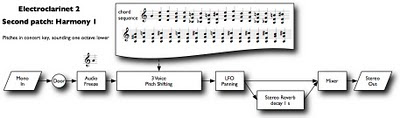
At the end of the serenade, at around 3:24 in the youtube Electroclarinet 2 video, I freeze the clarinet note. This frozen sound is heard synthesized at around 3:30, then transformed from 3:49 into a chord sequence. I especially like this sound processing, because it uses the harmonic sequence that Debussy composed in the third movement of his Sonata for Cello & Piano.

electroclarinet 2 sound processing 2
Patch #2: a sound is frozen live, then harmonized into a chord sequence.

electroclarinet 2 sound processing 4
Patch #4 is similar to patch #2, with a different harmonic sequence.
Sound is frozen at around 5:25, played back at 5:33, and the chord sequence starts around 5:40.

Arpeggios in a whole tone scale

electroclarinet 2 sound processing 5

The last live electronic sound processing in this composition is an arpeggiator, in other words, an harmonizer with individual delays. This piece being an homage to Debussy, I found it appropriate to use a whole tone scale. Note that whether the clarinet plays or not in the C whole tone scale is not important: the output of the arpeggiator always stays in the same scale. That enables me to use more tensions in the melody, while keeping the harmonic field coherent.